
Trigger Finger Treatment That Restores Confidence in Your Hand
Living with a finger that catches or locks often leads to adapting how you use your hand, but this does not resolve the underlying problem. Over time, the condition can become more limiting and less responsive to simple measures.
Dr. Schicker offers specialist treatment for trigger finger, helping patients move beyond temporary workarounds and toward a clear, reliable solution.
Book a consultation for trigger finger treatment in North Idaho
A clear assessment allows patients to move from uncertainty to a structured decision about the most appropriate way to restore normal movement.
What’s Actually Happening?
Before deciding on treatment, it helps to understand why the finger is behaving this way.
Understanding What Is Causing the Problem
Trigger finger, or stenosing tenosynovitis, is not a vague or generalized condition. It is a specific mechanical issue affecting how a tendon moves within the hand.
Each finger bends using a tendon that runs through a smooth, protective sheath. Along this sheath are small reinforced bands, called pulleys, which keep the tendon close to the bone. When this area becomes tight or inflamed, the tendon can no longer glide freely, which leads to the catching or locking seen in trigger finger.
As a result, the tendon can no longer move freely.
In the earlier stages, this restriction causes a catching or clicking sensation. As the condition progresses, the tendon may struggle to pass through the narrowed area, leading to the locking that patients experience.
This mechanical explanation is important, because it underpins every treatment decision. The goal is not simply to reduce discomfort, but to restore smooth, reliable movement.
Different Names for the Same Condition
Patients often encounter different terms for what is, in reality, the same underlying problem.
Trigger finger is commonly described in three ways:
• Trigger finger
• A locking or catching finger
• Stenosing tenosynovitis
What’s the Treatment?
The two most common uncertainties patients face are whether treatment is actually necessary and will surgery be necessary?
In mild cases, particularly when symptoms have only recently appeared, it is reasonable to take a conservative approach. Some patients choose to monitor the condition, modify activities, or try simple measures to reduce strain on the finger.
However, there is usually a point at which the balance shifts.
When the finger begins to lock regularly, when pain interferes with daily activities, or when the hand no longer feels reliable, the condition has moved beyond something that is likely to resolve on its own. Patients often find themselves adapting how they use their hand, avoiding certain movements or relying on the other hand to compensate.
At this stage, the focus shifts from recognising the problem to deciding what to do about it.
For many, the answer becomes clear when it starts to affect routine tasks, work, or hobbies. The focus then turns to identifying the most appropriate way to restore normal function.
For patients who are understandably keen to avoid surgery, non-surgical treatment is often the first step.
In early or moderate cases, this can be very effective. Reducing inflammation around the tendon sheath can allow the tendon to move more freely, relieving both the catching sensation and the associated pain.
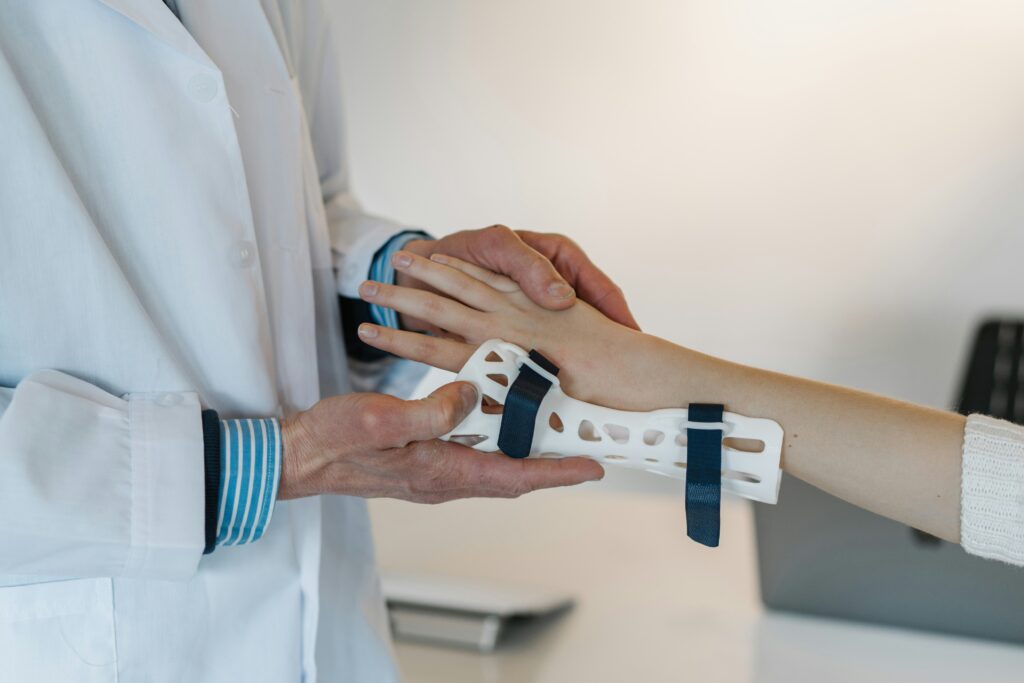
While rest, splinting, and anti-inflammatory measures may play a role, the most reliable non-surgical treatment is typically a corticosteroid injection. This is delivered directly to the affected area, targeting the source of the restriction.
When used at the right stage of the condition, injections can produce a significant improvement. Many patients notice a gradual return to smoother movement over the course of a few days, with a reduction in both stiffness and discomfort.
For some, this is sufficient to resolve the problem entirely.
The outcome depends on several factors, including how long the condition has been present, how severe the restriction has become, and how the finger is behaving on a day to day basis. In cases where the tendon sheath has become more significantly thickened, or where the finger is already locking frequently, the underlying mechanical issue may not fully respond to anti-inflammatory treatment alone.
Patients sometimes experience partial improvement, where pain is reduced but the catching persists. In other cases, symptoms improve initially but return over time.
This can lead to a pattern where injections provide temporary relief, but do not offer a lasting solution. At that point, the focus shifts from managing the condition to resolving it more definitively.
One of the most important parts of the treatment process is deciding when to move from non-surgical to surgical options.
This is rarely a single, clear-cut moment. Instead, it tends to evolve based on how the condition responds to initial treatment.
A common scenario is that the first injection produces a good result, but symptoms gradually return. A second injection may still be considered, particularly if there was a meaningful period of relief. However, if the duration or quality of improvement diminishes, repeating the same treatment becomes less likely to provide a satisfactory outcome.
At this stage, the decision is not simply about avoiding surgery. It is about whether continuing with temporary measures is delaying a more reliable solution.
Dr. Schicker’s role is to help patients interpret this progression correctly, taking into account how their individual case has developed rather than relying on general assumptions.


Surgical Treatment: A Targeted and Reliable Approach
When trigger finger persists or progresses despite non-surgical treatment, surgery offers a direct solution to the underlying problem.
The procedure is designed to release the tightened portion of the tendon sheath, creating enough space for the tendon to glide freely again. It is a focused intervention, addressing the exact point where movement is restricted.
For patients, one of the most reassuring aspects of the procedure is its simplicity. Dr. Schicker typically performs the surgery as an outpatient, in-office procedure that takes less than 15 minutes under local anaesthetic. There is no need for an overnight hospital stay, no tourniquet is used, and no need to fast in preparation the night before. Patients can even usually drive themselves home afterwards.
More importantly, the aim is clear and specific: to restore smooth, predictable movement in the affected finger.
For those who have been dealing with locking or unreliable movement, this often represents a turning point where the condition is finally resolved.
Understanding what happens after treatment is a key part of making an informed decision.
Following an injection, patients may experience some initial soreness at the injection site, but this usually settles quickly. Improvement in movement often begins within a few days, with a gradual reduction in stiffness and pain. In cases where the condition is less advanced, this may lead to a full recovery.
However, it is important to recognise that symptoms can return, particularly if the underlying mechanical restriction has not been fully addressed.
After surgical treatment, the locking is typically resolved immediately, as the restriction has been physically released. There may be some post-procedure discomfort, but this is usually manageable and short lived. Over the following weeks, movement continues to improve as the finger returns to normal use.
Most patients are able to resume everyday activities relatively quickly, with a low likelihood of recurrence.
A recurring pattern seen in trigger finger cases is delayed treatment.
This is not due to neglect, but rather to adaptation. Patients often find ways to work around the problem, adjusting how they use their hand to minimize discomfort. While this can make the condition more manageable in the short term, it does not address the underlying issue.
As time goes on, the mechanical restriction can become more pronounced, and the likelihood of non-surgical treatment being fully effective may decrease.
Addressing the condition earlier does not necessarily mean choosing surgery sooner, but it does create more flexibility in how it can be treated. It allows patients to consider options while the condition is still more responsive, rather than waiting until it has progressed further.
Getting Trigger Finger Treatment in North Idaho
Choosing the right treatment is not simply a matter of selecting from a list of options. It requires an understanding of how the condition has developed, how it is currently behaving, and what outcome the patient is hoping to achieve.
With expertise locked finger treatment, Dr. Schicker is a surgeon who works with patients at every stage of the condition. Some present early, when symptoms are still intermittent. Others seek help after months of persistent locking or after non-surgical treatments have already been tried.
In each case, the approach is the same. The focus is on providing a clear assessment, explaining the realistic outcomes of each option, and helping the patient make a decision that aligns with both the severity of the condition and their personal preferences.
This ensures that treatment is not only appropriate, but also understood.
Making a Clear and Confident Decision
Once it is clear what is causing the problem, how advanced it is, and what each treatment option offers, the decision becomes much more straightforward. Uncertainty is replaced by a structured understanding of what to expect.
Rather than weighing vague possibilities, patients are able to choose between defined outcomes, whether that is attempting non-surgical treatment with an understanding of its limitations, or proceeding with a more definitive solution.
This clarity is what allows patients to move forward with confidence.
Book an Assessment
If you are experiencing a finger that catches, locks, or becomes painful during everyday use, the next step is not committing to a particular treatment.
It is understanding your options.
An assessment with Dr. Schicker will provide a clear explanation of what is happening, how advanced the condition is, and what treatments are most likely to resolve it effectively.
From there, you can make an informed decision about the best way forward, based on your symptoms, your priorities, and the outcome you want to achieve.